A mortgage is a loan for a home, with the home itself as security. If the payments stop, the lender can eventually take the property to recover what it's owed. That security is why mortgage rates are so much lower than credit card rates: the lender has something to fall back on.
Everything else about a mortgage comes down to three numbers. How much you borrow, the interest rate, and how long you take to pay it back.
The principal and the down payment
The principal is the amount you borrow. It's the purchase price minus your down payment, the part you pay yourself.
In Canada, the minimum down payment depends on the price. As of 2026 it's 5% of the first $500,000 and 10% of the portion above that, on homes up to $1.5 million. Put down less than 20% and the mortgage needs mortgage default insurance, usually from CMHC, Sagen or Canada Guaranty. The premium protects the lender, not you, and it's normally added to the mortgage balance.
Interest: the cost of borrowing
Interest is what the lender charges for the money. It's quoted as a yearly rate, but it's charged on whatever you still owe. That one detail explains most of how a mortgage behaves.
Canadian law also requires fixed-rate mortgage interest to be compounded no more often than twice a year, so a Canadian mortgage at 4.25% costs slightly less than a US one at the same quoted rate. The calculators on this site use that Canadian method.
Amortization: the payoff timeline
The amortization is the total time it would take to pay the mortgage off completely, if the rate and payment stayed the same. Twenty-five years is common. Some borrowers can choose 30.
The lender sets a payment that, kept up for the whole amortization, brings the balance to exactly zero. That payment stays level, but what it's made of changes every month.
A worked example
Say you borrow $400,000 at 4.25% over 25 years, paid monthly. These figures are estimates, based on that rate holding for the whole period, which in practice it won't.
| Amount | |
|---|---|
| Monthly payment | $2,158.64 |
| First month: interest | $1,404.28 |
| First month: principal | $754.36 |
| Balance after 5 years | about $349,700 |
| Interest paid over 25 years | about $247,600 |
In the first month, about two-thirds of the payment is interest. Only $754 actually reduces what you owe. Each month the balance is a little smaller, so the interest is a little smaller, and a little more of the same payment goes to principal. By the final years almost all of it does.
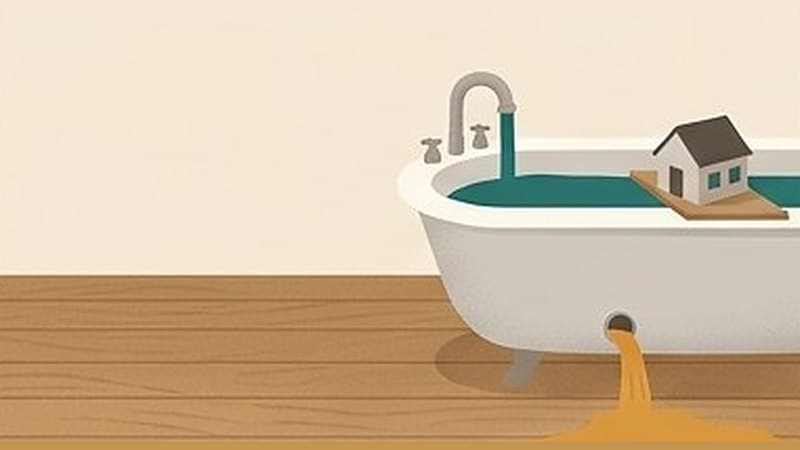
Think of it like filling a bathtub with the drain open. Early on, most of the water (your payment) runs straight down the drain (interest). As the level drops, less escapes, and the tub empties faster.
What a longer amortization costs
Stretch the same mortgage to 30 years and the payment drops to about $1,959, roughly $200 a month less. Total interest rises to about $305,300, around $58,000 more.
Neither is right or wrong. A lower payment can make a budget workable, and many people use prepayments later to shorten the timeline again. It's just worth seeing both numbers before choosing.
Try it
Where each year's payments go
A $400,000 mortgage. Every bar is one year of payments: the same total each year, but the split changes. Drag the sliders and watch the amber shrink faster or slower.
Monthly payment
$2,159
Total interest
$247,592
First payment that's interest
65%
$1,404 of $2,159
- Principal (pays down what you owe)
- Interest (the cost of borrowing)
Where to go next
The amortization is the long view. Your actual contract with the lender is usually much shorter, and that's where rates, renewals and penalties come in. That's the next lesson.
Worked figures are estimates based on the example inputs shown, checked October 11, 2026. Rates, rules and lender policies change, and your own numbers will differ. This is educational information, not financial advice.