
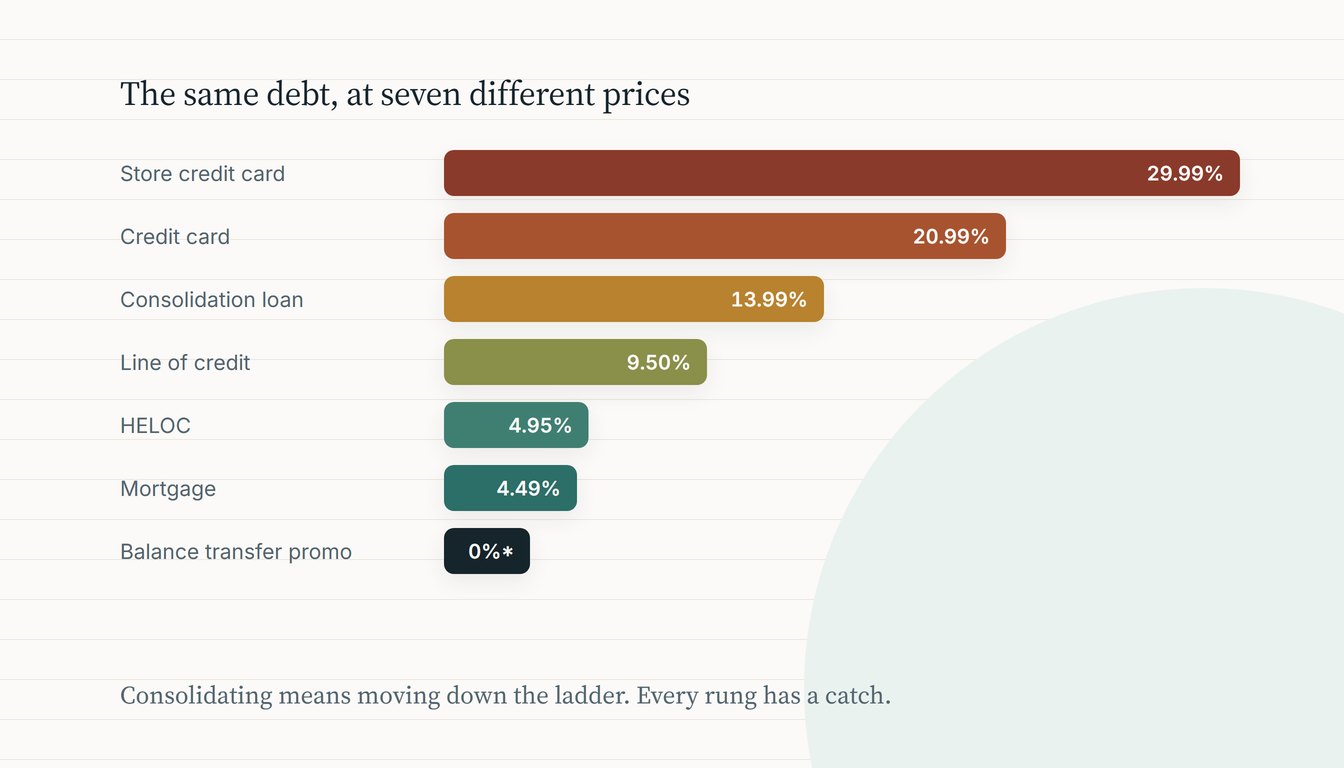
"Consolidating debt" sounds like one thing. It's really a ladder. At the top is a store card charging 29.99%. At the bottom is your mortgage at four-and-something. Every rung in between is a way of moving what you owe from an expensive place to a cheaper one, and each comes with its own catch.
Most people only hear about the bottom rung, because that's the one with a salesperson attached. This walks down the whole ladder, with the arithmetic, so you can see which rung fits the amount you actually owe.
Here's the ladder, using rates typical in Canada in September 2026:
| Where the debt sits | Typical rate |
|---|---|
| Store credit card | 29.99% |
| Regular credit card | 19.99% to 22.99% |
| Unsecured consolidation loan | 10% to 15%, depending on credit |
| Unsecured line of credit | 8% to 11% |
| Home equity line of credit (HELOC) | about 4.95% (prime + 0.5) |
| Mortgage | about 4.5% |
| Balance transfer promotion | 0% to 0.99%, for 9 to 18 months |
Rung one: stop the debts working against each other
Before moving anything anywhere, there's a free strategy. It's the one every other option is secretly relying on.
Dev has three debts: $9,000 on a card at 22.99%, $6,000 on another at 19.99%, and $3,000 on a line of credit at 8.95%. He pays $280, $190 and $130 a month, $600 in all. Left alone, with each payment stopping when its debt clears, he's done in a little over four years and pays about $8,000 in interest.
Now two changes. He finds another $150 a month, and whenever a debt clears, its payment rolls onto the next one instead of vanishing into groceries.
| Done in | Interest | |
|---|---|---|
| As he was, $600 a month, nothing rolled forward | 4.2 years | $8,007 |
| $750 a month, highest rate first ("avalanche") | 2.6 years | $5,119 |
| $750 a month, smallest balance first ("snowball") | 2.7 years | $5,604 |
The internet argues endlessly about avalanche versus snowball. On Dev's numbers the difference is about $500 and one month. The difference between either of them and doing nothing is nearly $3,000 and a year and a half. Pick whichever one you'll actually stick to. Highest rate first is cheaper; smallest balance first gives you a win sooner, and some people need the win.
Rung two: the balance transfer
This is the day-to-day tool, and the one most worth understanding properly.
A balance transfer card lets you move a balance from another issuer's card and pay little or no interest on it for a promotional period. At the time of writing, the offers comparison sites are listing in Canada run from 0% for 9 months with a 1% fee up to 0% for 18 months with a 2% fee, with a common middle of 0% for 12 months at 3%. BMO, MBNA, Scotiabank and CIBC all have one. Offers change monthly, so check the issuer's own page, not a blog post, before applying.
Priya owes $8,000 on a card at 20.99% and pays $400 a month. As things stand she's clear in 25 months and pays $1,932 in interest.
She moves it to a 0%-for-12-months card with a 3% fee. The fee is $240, so she now owes $8,240.
- If she raises her payment to $687, the balance is gone on the last day of the promotion. Total cost: the $240 fee. She's saved about $1,700.
- If she keeps paying $400, she still owes $3,440 when the promotion ends and the rate snaps back to around 21%. It takes another ten months and about $320 of interest. Total cost: about $560. Still $1,370 better than staying put.
So it works even when you don't clear it in time. The number to find before you apply is the balance divided by the months: that's the payment that makes the promotion do its full job.
Where balance transfers go wrong
Canada's banking ombudsman has flagged a rise in balance transfer complaints, and they cluster around the same few clauses:
- New purchases aren't at 0%. They're charged the card's regular rate, often from the day you buy, with no grace period while a transferred balance is sitting there. The clean approach is to put the new card in a drawer and never buy anything on it.
- One missed payment can end the promotion. Most agreements let the issuer cancel the promotional rate if you miss a minimum payment or go over your limit. Set up an automatic payment the day the card arrives.
- You can't transfer between cards from the same bank. The offer is there to win customers from a competitor.
- The limit you're given may be smaller than the debt. You find out after you're approved. A $5,000 limit against an $8,000 balance still helps; it just doesn't finish the job.
- The old card is still open. A transfer frees up the whole limit on the card you just emptied. Whether that's a safety net or a trap is a fair question to ask yourself honestly.
- Promotions end. Whatever is left goes to the regular rate, which on these cards is usually 12.99% to 22.99%.
One more: the low-rate card, as distinct from the promotional one. A few Canadian cards charge a permanent 12.99% or so for a small annual fee. It's not exciting, but if your balance will take longer than a year to clear, a permanent 13% can beat a 0% that turns into 21%.
Rung three: a line of credit or a consolidation loan
When the total is too big for a card limit, or will take more than a year or two, the next rung is unsecured borrowing from a bank or credit union.
Marc and Élise owe $9,000 at 19.99% and $6,000 at 22.99%, paying $500 a month between them. On the cards that's 3.8 years and $6,589 of interest.
| $15,000, paying $500 a month | Done in | Interest |
|---|---|---|
| On the two cards | 3.8 years | $6,589 |
| Consolidation loan at 13.99% | 3.2 years | $3,567 |
| Unsecured line of credit at 9.5% | 2.9 years | $2,194 |
The line of credit is cheaper and more flexible. It's also the more dangerous of the two, for one reason: the minimum payment on a line of credit is often interest only, which on $15,000 at 9.5% is about $119 a month. Pay that and you will owe $15,000 forever. A loan has a fixed payment and an end date built in, which is exactly what some people need to be given.
Both depend on your credit. If the cards are already near their limits, the rate you're offered may be closer to the top of the range than the bottom, and it's worth asking before you assume.
Rung four: borrowing against the house with a HELOC
If you own a home with equity in it, a HELOC is usually the cheapest money available without touching your mortgage: around prime plus half a point, so roughly 4.95% today. There's no penalty, because you aren't breaking anything, and you pay interest only on what you use.
On $40,000 of debt, the interest-only payment is about $165 a month. That's the appeal, and that's the problem. Pay $165 and the $40,000 never moves. Pay $800 a month and it's gone in under five years for about $4,900 in interest.
Two things to know. The rate floats with prime, so it moves when the Bank of Canada does. And the debt is now secured against your home, which is why it's cheap. A HELOC suits an amount you intend to clear in a few years with a payment you set yourself and stick to.
Rung five: rolling it into the mortgage
The bottom rung, the lowest rate, and the biggest decision. You refinance the mortgage for more than you owe and use the difference to clear everything else.
It can be the right tool when the amount is large, when a renewal is coming anyway so there's no penalty, or when the monthly total has simply become unmanageable. Take a household with a $420,000 mortgage and $65,000 across cards, a line of credit and a car loan, paying $3,957 a month in total:
| Monthly | Interest until everything is repaid | Debt-free in | |
|---|---|---|---|
| Everything as it is | $3,957 | $260,898 | 22 years |
| Consolidated, lower payment | $2,690 | $320,483 | 25 years |
| Consolidated, still paying $3,957 | $3,957 | $164,105 | 13.8 years |
The middle row is what gets advertised: $1,267 a month of breathing room. It's real. It also costs about $60,000 more interest, because a car loan that had four years to run now has twenty-five.
The bottom row is what a mortgage consolidation is capable of when the old payments keep going to the new mortgage. Same money out the door, everything cleared in under fourteen years.
The rules worth knowing: a refinance in Canada is capped at 80% of your home's appraised value, you have to qualify again on income and credit, there are legal and appraisal costs, and mid-term there's a penalty to break the existing mortgage. Our debt consolidation calculator does all of this with your own numbers, including the 80% check, and shows those three rows side by side. If you're mid-term, the break calculator will estimate the penalty to put into it.
Choosing a rung
There's no best rung, only one that fits the size of the debt and how long you need.
- A few thousand dollars, clearable in a year: a balance transfer, with the card in a drawer.
- $10,000 to $30,000 over two to four years: a line of credit or a loan, with a fixed payment you choose.
- Larger amounts, with home equity: a HELOC if you'll clear it in a few years; the mortgage if you need the lower payment or a renewal is near.
- Any amount: rung one still applies. Roll every cleared payment onto the next debt.
One thing is true of every rung. Consolidating lowers the rate. It doesn't lower the debt, and it frees up the credit you just paid off. The strategies that work are the ones where the emptied cards stay empty, and the payment you were already making keeps being made.
If the mortgage rung is the one you're weighing, run your numbers through the debt consolidation calculator. It runs in your browser, nothing you type is sent to us, and the result prints cleanly to take to a broker or your bank.
People in this post are illustrative composites. Rates and card offers are typical of what was advertised in Canada in September 2026 and change often; confirm any offer with the issuer. All figures are estimates. This is general information, not advice about your situation, and nothing here is a recommendation.