
Somewhere in your house there is an envelope from your lender, or there will be soon. Inside is a rate that starts with a four, where five years ago it started with a one. Everybody knows that part. What almost nobody knows until they sit down with it is what that does to their month, and how many ways out of it there are.
So here are four households, each opening the same envelope in a different situation. They're composites, not clients, and we ran every one of them through our renewal calculator. You can put your own numbers in when you're done.
1. Stretched: no savings, and $789 a month to find
Maya and Chris bought in 2021 with everything they had. They owe $610,000, have 22 years left, and are moving from 1.94% to 4.49%.
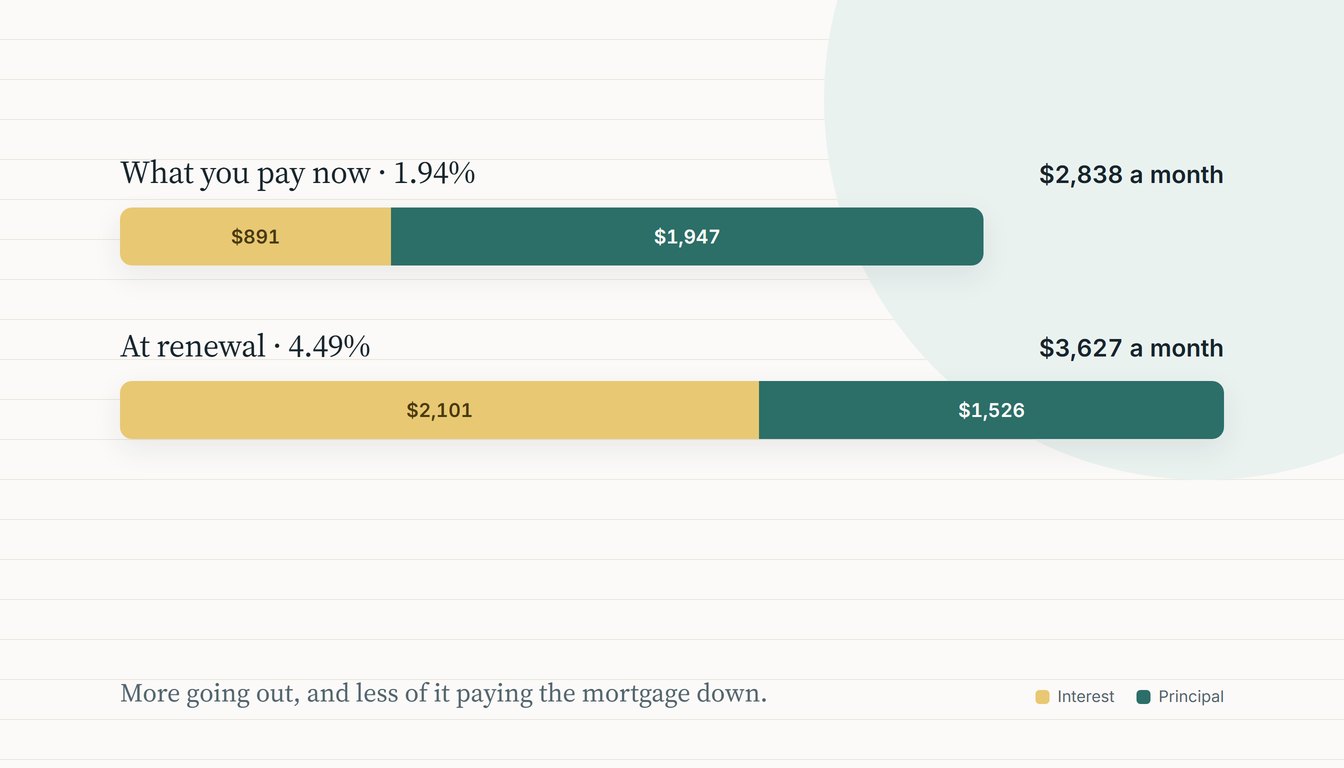
Their payment goes from $2,838 to $3,627. That's $789 a month, up 28%, arriving in the same year as daycare.
The detail that stings is inside the payment. At the old rate, $891 of each month was interest and the rest paid the house down. At the new rate, $2,101 is interest. They'll pay $789 more and make slower progress.
With no lump sum to throw at it, their real lever is time. If they can stretch the amortization when they renew:
| Keep 22 years | Stretch to 25 | Stretch to 30 | |
|---|---|---|---|
| Monthly payment | $3,627 | $3,373 | $3,072 |
| More than today | $789 | $535 | $234 |
| Interest over the life of the mortgage | $347,472 | $401,838 | $495,980 |
Thirty years makes the renewal almost painless, and costs roughly $148,000 more in interest if they never touch it again. That isn't a reason not to do it. Breathing room during the expensive years has real value, and an amortization can be shortened again later with prepayments. It's a reason to know the price. One practical note: stretching usually means a refinance rather than a simple renewal, so it's a conversation to have with a broker or the lender a few months early.
2. The savers: the renewal that never reached the budget
This one is a real renewal, rounded, and we wrote it up in full here. About $520,000 owing, 20 years left, 1.80% to 3.90%, and $104,000 sitting in a TFSA.
Do nothing, and the payment goes from $2,580 to $3,115.
Put the $104,000 down and let the lender recalculate, and the new payment is $2,492. Lower than it was at 1.80%. A 20% lump sum swallowed a two-point rate rise whole.
Then comes the fork most people don't know is there. Keep paying the full $3,115 anyway, and the mortgage is gone in 14.6 years instead of 20, with about $53,000 less interest than the lower-payment version. Same lump sum, two very different outcomes, decided by one tick box on a renewal form.
3. Nearly there: small shock, short road
Anne owes $165,000 with nine years to go, moving from 2.04% to 4.39%. Her payment rises from $1,673 to $1,849. That's $176 a month: annoying, not alarming. Small balances and short amortizations blunt a rate rise, because there's less debt for the new rate to work on.
Her question is different. She's close enough to see the end, and she wants to know how to bring it nearer.
- Accelerated biweekly. $925 every two weeks. Mortgage-free in 8.2 years instead of 9, about $3,700 less interest, for roughly $160 a month more than the plain renewal.
- A $25,000 lump sum, payment unchanged. Done in 7.4 years, and about $10,700 less interest.
Neither number is dramatic, and that's the honest finding. Late in a mortgage most of each payment is already principal, so there's less interest left to save. The early years are where prepayment does its heavy lifting.
4. The one whose payment goes down
Not everyone renewing this year signed in 2021. Sam took a three-year fixed at 6.14% in 2023, near the top. He owes $480,000 with 22 years left and is renewing at 4.49%.
His payment drops from $3,297 to $2,854. He's $443 a month better off and could simply enjoy it.
Or he could notice that he's already living on the higher payment. If he switches to accelerated biweekly, he pays $1,427 every two weeks. That's still about $196 a month less than he pays today, and it takes nearly three years off the mortgage and about $40,000 off the lifetime interest. He gives back a little more than half his windfall and never feels it, because he never had it.
What the four have in common
The payment is only the headline. In every case the more revealing number is the split between interest and principal. The calculator draws it as two bars to the same scale, and it's the quickest way to see what a rate change really did.
A lump sum is two decisions. How much, and what happens to the payment afterwards. The second one often matters more.
"Accelerated" means paying more, not paying more often. Half the monthly payment every two weeks is thirteen monthly payments a year. Plain biweekly changes almost nothing. We laid out every schedule in Weekly, biweekly or monthly.
A rule of thumb for the envelope. On a 20-year amortization, each percentage point costs about $50 a month for every $100,000 you owe.
The letter is an offer. At renewal you can move lenders without a prepayment penalty, though there may be discharge, legal or appraisal costs and a new lender will assess you. Half a point on $450,000 is about $110 a month, so the rate is worth a conversation. If you haven't been quoted yet, our rates page shows what we currently estimate and how we get there.
Your turn
The renewal calculator puts what you pay now, renewing with nothing changed, and renewing with your changes side by side, with every row lined up. It runs in your browser, nothing you type is sent to us, there's no sign-up, and the result prints cleanly if you want to take it to a broker.
One caution when you read it. The five-year figures are solid. The life-of-the-mortgage figures assume the new rate never changes, which it will at the next renewal, so use them to compare one option with another rather than as a forecast.
If you're thinking about leaving your mortgage before the term ends, that's a different question with a penalty attached, and the break calculator handles it.
The households are illustrative composites, except the second, which is a real renewal with rounded figures. All numbers are estimates using the semi-annual compounding Canadian fixed-rate mortgages use. Your lender's figures will differ, and nothing here is a recommendation.